

Urbandale, IA · What we treat
Women’s pelvic health in Urbandale.
Leaking when you run, pelvic or tailbone pain, a core that hasn’t felt like yours since pregnancy: common is not the same as normal. A cause-first evaluation finds out why, then a plan with an endpoint gets you back to the workout, the lift, and the long day without planning around it.
You’ve probably said one of these.
Nobody walks in describing pelvic floor dysfunction. They describe weeks like these. Tap one that sounds like yours.
-
UsuallyStress urinary leakage, a pelvic floor that isn’t keeping up with the pressure that impact, coughing, or a heavy lift puts on it.
Why does this happen ⟶ -
UsuallyPostpartum core weakness or abdominal separation (diastasis recti), a system that was never retrained after pregnancy, not one that’s permanently changed.
Why does this happen ⟶ -
UsuallyPelvic girdle pain, the joints at the front and back of the pelvis irritated by the load and hormonal changes of pregnancy.
Why does this happen ⟶
- “I map out where the bathrooms are before I agree to go anywhere.”
- “Sitting through a long meeting, it’s my tailbone I’m thinking about.”
- “Everyone told me this is just what happens after kids.”
If two or three of those sound like your week, you’re not describing something you have to live with. You’re describing a pattern we see often, and one an evaluation is built to explain.
Why do pelvic health problems happen?
The pelvic floor is a group of muscles doing several jobs at once: support, control, and stability for the hips and low back. When one of those jobs falls behind, what we usually find, alone or in combination:
- Pregnancy and postpartum changes. Months of added load, stretched abdominal wall, and delivery itself, followed by a return to lifting a baby and a car seat with a core that was never retrained.
- Stress urinary leakage. Leaking with a cough, sneeze, laugh, run, or jump, usually a pelvic floor that isn’t timing or strong enough for the pressure being put on it.
- Diastasis recti. Separation of the abdominal muscles along the midline after pregnancy, often felt as a doming belly or a core that won’t brace.
- Pelvic girdle and SI joint pain. Pain at the front of the pelvis, the low back, or deep in the buttock, common during pregnancy and after, and easy to mistake for a back or hip problem.
- A pelvic floor that’s too tight. Muscles that stay guarded instead of relaxing, which can show up as pelvic pain, tailbone pain, or urgency, and needs the opposite of more squeezing.
None of these are diagnoses you make yourself, and “just do more Kegels” is the wrong answer for a lot of them. That’s what the evaluation sorts out, and if anything looks like it needs a physician first, we’ll say so and point you there directly.
How do we treat pelvic health concerns in Urbandale?
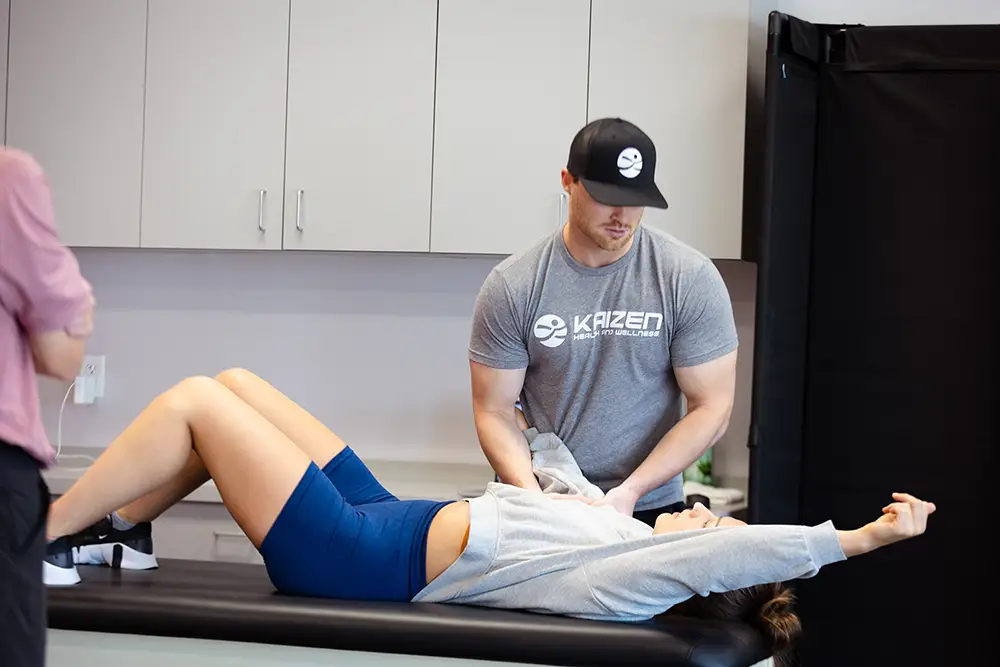
Treatment starts with a private, one-on-one evaluation: how your breathing, core, hips, and low back work together with the pelvic floor, not just the symptom that brought you in. We explain every step before we do it, and you decide what you’re comfortable with. From there, care moves through four named phases.
The plan’s endpoint is named at your evaluation, reviewed with you every phase, because the goal is to get you back to your week, not to keep you on the schedule.
Calm it down.
Hands-on work for the hips, low back, and pelvis, plus breathing and positions that take pressure off irritated tissue, starting the first visit.
Reconnect the system.
Retraining how the pelvic floor, deep core, and breath work together, whether that means building strength or learning to let a guarded floor relax.
Build strength you trust.
Progressive loading for lifting, running, and impact against standards you clear before moving on, so the jump, the sprint, and the car seat stop being things you brace for.
Make it stay fixed.
Testing before you’re cleared, then a home program sized to your week, whether that’s a return to training or a plan for the next pregnancy.
What does getting better look like?
Women who book an evaluation for pelvic health concerns have often been told, by friends or by a quick appointment, that this is just part of having kids or getting older. More often, it’s a slower story: a few years of skipping the jump, wearing a pad to the gym, or sitting on the edge of the chair to spare the tailbone.
Progress tends to show up in ordinary places first: a sneeze you didn’t brace for, a run that ends because you’re done rather than because you’re worried, picking up your kid without thinking about your core first.
Left alone, pelvic floor problems rarely fix themselves; they tend to shrink your week a little at a time, one skipped workout and one planned-around outing after another.
An evaluation turns that guesswork into a plan with a specific estimate, reviewed with you at every phase.
Which services treat pelvic health concerns?
Physical Therapy
Is the foundation of treatment: the cause-first evaluation and the four-phase plan that runs the whole recovery.
02Manual Therapy
Hands-on work for the hips, low back, and pelvis when stiffness or guarding is part of what’s keeping symptoms going.
03Orthopedic Therapy
Treatment for the pelvic girdle, SI joint, and low back pain that often travels with pelvic floor concerns.
04Pre & Post-Surgical Rehabilitation
A plan matched to your surgeon’s protocol when recovery follows a C-section or other abdominal or pelvic surgery.
Questions, answered plainly.
The things people ask on the phone about pelvic health, written down.
It’s common, but common isn’t the same as something you have to accept. Leaking with a cough, a run, or a jump usually means the pelvic floor isn’t keeping up with the pressure on it, and that’s something that can be retrained, whether your last pregnancy was one year ago or twenty.
Many women start once they’ve been cleared at their postpartum checkup, often around six weeks, but it’s never too late. Breathing and gentle core work can begin earlier with your provider’s okay, and we can also work with you during pregnancy for back and pelvic pain.
A private, one-on-one conversation about your history and goals, then an assessment of how your breathing, core, hips, and low back move and work together. We explain everything before we do it, nothing happens without your consent, and you’ll leave with a plan and something to start on that day.
Sometimes, but not always. For some women the pelvic floor is weak and needs strengthening; for others it’s already too tight, and more squeezing makes pain or urgency worse. Your evaluation tells you which one you’re dealing with, so you’re not guessing.
Start with a cause-first evaluation for your pelvic health.
Put it in writing.
Five short questions. A real person calls you back, usually within two business hours, with times that fit your week.
The people who end up filling this out are rarely in the worst pain of their life. They’re just done working around it, done picking the errand that doesn’t require the stairs. If that’s the stage you’re at, this is the part where you stop researching and start.
Consider it filed.
A real person will call you back, usually within two business hours, with appointment times that fit your week. Keep your phone nearby.
Can’t wait? Call (515) 207-2450 ⟶Easy to find. Easy to park.
In the neighborhood, with parking by the door. Come see the place before you commit, if you like.
The clinic · Kaizen Health and Wellness
Get Directions ⟶Opens in Google Maps