

Urbandale, IA · Services
Blood flow restriction training in Urbandale.
Personalized strength training under partial blood flow restriction: real strength gains at lighter loads, built for joints that can’t tolerate heavy weight yet.
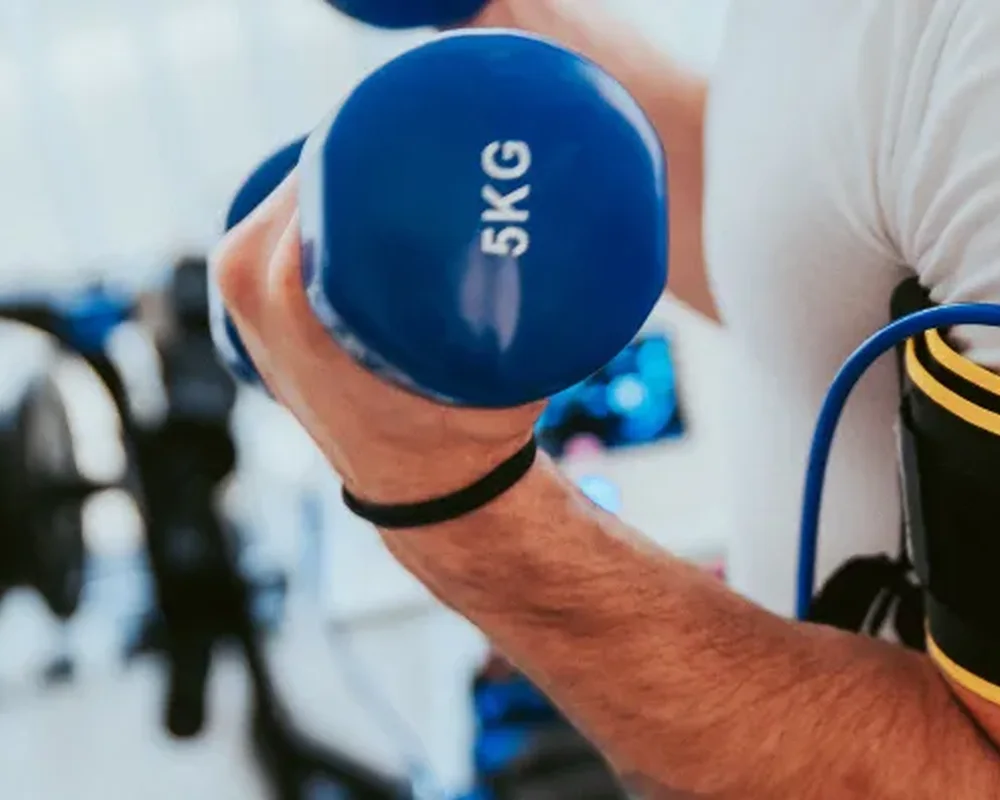
What is blood flow restriction training in Urbandale?
Blood flow restriction training uses a pressurized cuff, placed high on the arm or leg, to partially limit blood flow to a working muscle during light-load exercise. The muscle responds as though it’s under a much heavier load than it actually is, which means real strength and size gains at a fraction of the weight.
That matters most for a joint or tissue that isn’t ready for heavy load yet: early after surgery, recovering from an injury, or protecting a joint that can’t tolerate the stress heavy lifting would put on it. Your Doctor of Physical Therapy sets the cuff pressure and the exercise personally, based on your evaluation, not a generic percentage pulled from a chart.
It’s built into the same four-phase plan as everything else here, Pain, Prime, Perform, and Prevent, usually earning its place in Prime and Perform, when strength needs to come back faster than the joint can currently tolerate loading it directly.
Calm it down.
Hands-on treatment begins at the first visit. You leave understanding what’s actually going on, and you feel a difference early.
Restore what’s stuck.
Targeted mobility work for the joints and tissue actually holding you back, dosed to your body, not a printed sheet.
Build strength you trust.
Progressive load against standards you have to clear before moving on. Confidence, here, is a training effect.
Make it stay fixed.
Testing before you’re cleared, then a keep-it-gone program sized to your real week. Then we graduate you.
What conditions does blood flow restriction training support?
Blood flow restriction training tends to get called in where the joint or tissue involved can’t yet tolerate the load that normal strength training would require. A sample of what it commonly supports:
ACL rehab ⟶
The reconstructed knee that needs strength back long before it can handle heavy squats.
02Pre & post-surgical rehab ⟶
The joint that’s healing from surgery and isn’t ready for its old training load.
03Knee pain ⟶
The knee that aches under real weight but still needs the muscle around it built back up.
A joint that waits for full strength to return before doing any loading tends to lose more muscle than it needed to. Training around the limitation, instead of just waiting it out, usually gets you back to full load faster.
What does a blood flow restriction session look like?
Your Doctor of Physical Therapy fits a pressurized cuff around the top of the limb being trained, set to a pressure calculated for you personally, then walks you through a set of light-load exercises, think a fraction of what you’d normally lift, at higher repetitions.
The cuff comes off between exercises or at set intervals to keep circulation safe, and your doctor stays with you the entire session to monitor how the limb is responding. Most people feel a deep muscular fatigue similar to a much heavier workout, without the joint stress that would come with actually lifting that heavy.
Who this is for, and who it isn’t.
Blood flow restriction training tends to fit people whose joint or tissue can’t yet tolerate heavy load: someone a few weeks out from surgery, recovering from an injury that heavy lifting would aggravate, or working around a joint condition that limits how much weight is safe. It’s a way to keep building strength while the rest of the plan protects the joint.
The people who benefit most are usually frustrated that resting and waiting is the only option they’ve been given, when there’s a way to keep training safely instead.
It’s not appropriate for certain vascular conditions, a history of blood clots, uncontrolled high blood pressure, or active infection in the limb; your evaluation screens for all of that before a cuff ever goes on.
Good fit
- Recovering from surgery or an injury that heavy lifting would aggravate
- A joint condition that limits how much weight is currently safe to load
- Wanting to keep building strength instead of just resting and waiting
- Cleared by your evaluation for cuff-based training
Not the right fit
- Certain vascular conditions or a history of blood clots
- Uncontrolled high blood pressure
- Active infection in the limb being trained (screened at evaluation)
It’s a training tool inside the plan, never a stand-alone service.
“Bryan is fantastic. He blends a hybrid of PT with strength and conditioning to allow yourself to reach your highest potential.”Brennan R. · Google review
Questions, answered plainly.
Done correctly, yes. The cuff pressure is calculated for you personally, not applied at a flat setting, and your Doctor of Physical Therapy monitors you throughout the session and screens for the few conditions, like clotting disorders or uncontrolled blood pressure, where it isn’t appropriate.
Yes, that’s the point of the technique. Restricting blood flow during light-load exercise creates a metabolic environment that signals the muscle to adapt as though it’s under much heavier load, which produces real strength and size gains at a fraction of the weight your joint would otherwise need to handle.
It depends on your procedure and your surgeon’s protocol, which your Doctor of Physical Therapy reviews at your evaluation. Many post-surgical patients start earlier with blood flow restriction than they could with traditional heavy loading, since the joint itself isn’t being asked to bear the weight.
It depends on your recovery timeline and how your strength responds. It’s typically used through Prime and Perform, as a bridge until the joint can tolerate normal loading, then it’s phased out as regular strength training takes over. Your Doctor of Physical Therapy will tell you at your evaluation whether it fits your plan at all.
Start with the evaluation that builds your strength plan.
Put it in writing.
Five short questions. A real person calls you back, usually within two business hours, with times that fit your week.
The people who end up filling this out are rarely in the worst pain of their life. They’re just done working around it, done picking the errand that doesn’t require the stairs. If that’s the stage you’re at, this is the part where you stop researching and start.
Consider it filed.
A real person will call you back, usually within two business hours, with appointment times that fit your week. Keep your phone nearby.
Can’t wait? Call (515) 207-2450 ⟶Easy to find. Easy to park.
In the neighborhood, with parking by the door. Come see the place before you commit, if you like.
The clinic · Kaizen Health and Wellness
Get Directions ⟶Opens in Google Maps