

Urbandale, IA · What we treat
Sports injuries in Urbandale.
Whether you’re a weekend rec-league regular or training for a season that matters, a cause-first evaluation tests what your sport actually demands from the injured area, then a plan with an endpoint gets you back to cutting, throwing, and sprinting at full speed, not just cleared to jog.
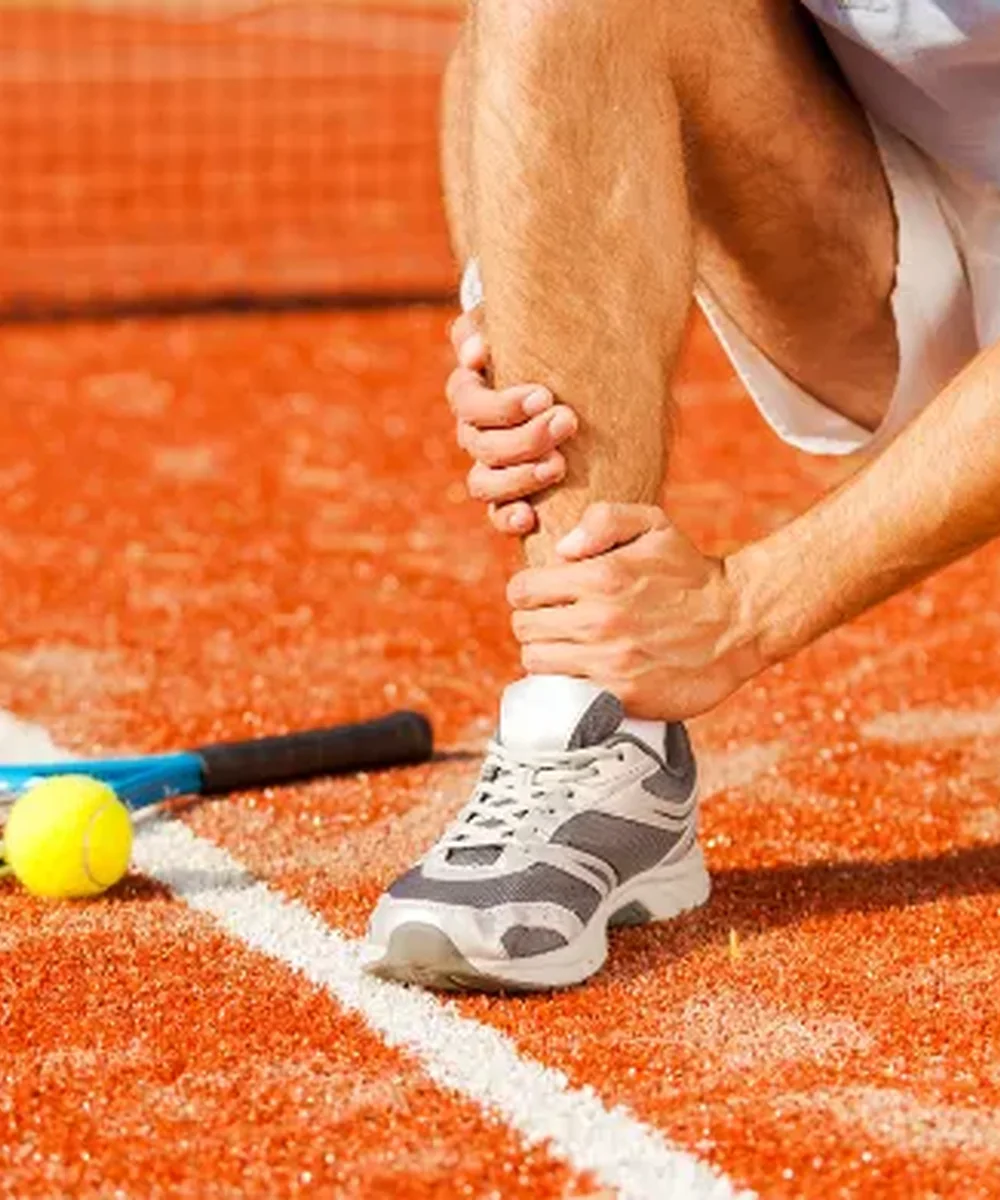
You’ve probably said one of these.
Nobody walks in describing a mechanism of injury. They describe days like these. Tap one that sounds like your week.
-
UsuallyA lingering stability deficit in the ankle that healed enough to walk on but hasn’t been tested against the sharp, lateral demands of your sport.
See how return-to-play testing catches that ⟶ -
OftenA fatigue-driven mechanical fault, meaning the shoulder holds up fine early but loses its form once the supporting muscles tire.
See how dry needling and strength work address it ⟶ -
UsuallyA fear of reinjury outlasting the actual injury, common once pain has gone quiet but confidence hasn’t caught back up.
See how the plan rebuilds that confidence ⟶
- “I taped it up and kept playing. That was two months ago and it still isn’t right.”
- “I can jog fine. It’s the first hard cut in a game that gives me pause.”
- “My coach keeps asking when I’ll be back to full speed and I don’t have a real answer.”
If two or three of those sound like your season, you’re not being dramatic about an old sprain. You’re describing a pattern we see often, at every level of competition, and one an evaluation is built to explain.
Why do sports injuries happen?
There’s rarely one single cause, which is exactly why guessing doesn’t work. What we usually find, alone or in combination:
- Overuse and repetitive strain. The same motion, a throw, a stride, a swing, repeated thousands of times a season past what the tissue was conditioned to handle.
- Acute trauma. A sprain, strain, or tear from a single hard contact, cut, or landing, distinct from the slow-building overuse pattern.
- Inadequate warm-up or recovery. Training loads that climb faster than the body’s ability to recover between sessions.
- Muscle imbalance. Sport-specific repetitive motion that overdevelops one muscle group while the opposing one quietly weakens.
- Returning too soon. Playing through, or returning from, a prior injury before it was actually tested and cleared.
None of these are diagnoses you make yourself, and most don’t require imaging to start treating. That’s what the evaluation sorts out.
How do we treat sports injuries in Urbandale?
Treatment starts with a cause-first evaluation: testing the injured area against the specific movements your sport demands, because a shoulder that’s fine reaching for a shelf isn’t necessarily fine mid-serve. From there, care moves through four named phases.
The plan’s endpoint is a set of testing standards matched to your sport, reviewed with you every phase, because the goal is clearing you to compete, not just clearing you to walk without pain.
Protect and calm it.
Managing acute pain and swelling while keeping you as active as the injury safely allows, starting the first visit.
Restore full motion.
Rebuilding pain-free range of motion and basic strength before any sport-specific load gets added back.
Train it like your sport.
Sport-specific strength and movement retraining, cutting, throwing, jumping, dosed against standards you clear before moving on.
Test before you play.
Return-to-play testing against your sport’s specific demands, plus an injury-prevention program before full clearance.
What does getting better look like?
Athletes who end up booking an evaluation for a sports injury are rarely the ones who came in the day it happened. More often, it’s a slower story: taped up, played through, quietly managed for a season before the pattern stopped being manageable. If that’s closer to your version, you’re the typical patient here, not an outlier, whether you’re competing at a high level or playing in a beer league.
Most patients notice a difference within the first two or three visits, since hands-on treatment starts at the evaluation itself. Progress tends to show up in specific movements first: a cut that stops hesitating, a serve that holds up into the third set, a landing that stops feeling one-sided. Played through without treatment, a sports injury rarely stays minor; compensating for one area tends to overload another, and a strain treated late is a longer road back than the same strain treated early.
An evaluation turns “can I still play” into a specific plan back to full speed, reviewed with you at every phase.
Which services treat sports injuries?
Physical Therapy
The foundation of treatment: the cause-first evaluation and the four-phase plan that runs the whole recovery.
02Sports Rehab
Handles the sport-specific loading and return-to-play testing that decide when you’re actually cleared to compete.
03Dry Needling
Targets the tight, overworked muscle tissue that repetitive sport-specific motion tends to load unevenly.
04Cupping
Supports soft-tissue recovery between training sessions, easing the guarding that builds up around an overworked area.
“I highly recommend Kaizen! I had been dealing with chronic neck pain for a couple of years due to a sports injury, and the team helped me finally get relief.”Katie L. · Google review
Questions, answered plainly.
The things people ask on the phone about sports injuries, written down.
Not always, and modified play is often possible during evaluation. Most plans keep you as active as the injury safely allows, with specific restrictions named at the evaluation rather than a blanket instruction to sit out.
The evaluation looks specifically at the movements your sport demands, cutting, throwing, jumping, sprinting, not just whether the injured area moves and hurts in isolation. Return-to-play testing checks you against those specific demands before you’re cleared.
There’s no single timeline that applies to every injury or every athlete. Return-to-play readiness is set by strength and movement testing specific to your sport, reviewed with you at every phase, not by a fixed number of weeks.
Untreated injuries rarely stay the same size. Compensating for pain in one area tends to overload another, and a minor strain played through often becomes a more serious injury by the time it’s finally evaluated.
Start with a cause-first evaluation for your sports injury.
Put it in writing.
Five short questions. A real person calls you back, usually within two business hours, with times that fit your week.
The people who end up filling this out are rarely in the worst pain of their life. They’re just done working around it, done picking the errand that doesn’t require the stairs. If that’s the stage you’re at, this is the part where you stop researching and start.
Consider it filed.
A real person will call you back, usually within two business hours, with appointment times that fit your week. Keep your phone nearby.
Can’t wait? Call (515) 207-2450 ⟶Easy to find. Easy to park.
In the neighborhood, with parking by the door. Come see the place before you commit, if you like.
The clinic · Kaizen Health and Wellness
Get Directions ⟶Opens in Google Maps