

Urbandale, IA · Services
Compression boots in Urbandale.
Pneumatic compression that speeds recovery between harder sessions, used as a tool inside your plan with a Doctor of Physical Therapy, not as a treatment on its own.

What is compression boots recovery in Urbandale?
Compression boots use sequential pneumatic pressure, inflating and releasing in a wave up the leg (or arm), to move fluid and encourage blood flow after exertion or injury. It’s recovery support, not treatment: nothing about a boot session finds the cause of your pain or fixes a joint that isn’t moving right.
That’s why it’s scheduled inside a plan here, never sold as its own appointment. Your Doctor of Physical Therapy uses it between harder sessions, especially in Perform, when training load is climbing and recovery time between visits matters as much as the work itself.
Care still moves through the same four phases, Pain, Prime, Perform, and Prevent. Compression boots support the plan; they don’t replace the hands-on treatment and loading work that’s actually changing your tissue and your strength.
Calm it down.
Hands-on treatment begins at the first visit. You leave understanding what’s actually going on, and you feel a difference early.
Restore what’s stuck.
Targeted mobility work for the joints and tissue actually holding you back, dosed to your body, not a printed sheet.
Build strength you trust.
Progressive load against standards you have to clear before moving on. Confidence, here, is a training effect.
Make it stay fixed.
Testing before you’re cleared, then a keep-it-gone program sized to your real week. Then we graduate you.
What does compression boots recovery support?
Compression boots tend to get added where exertion or a recent injury has left swelling or heaviness that’s slowing recovery between visits. A sample of what it commonly supports:
Knee pain ⟶
The post-training swelling that makes the next day’s session start from behind.
02Foot & ankle pain ⟶
The ankle that’s still puffy a day after you rolled it.
03Sports injuries ⟶
The heavy week of training that needs to clear before the next one starts.
04Pre & post-surgical rehab ⟶
The swelling that lingers after surgery long after the incision itself has healed.
Swelling that sticks around tends to slow down everything else in the plan, not just comfort. Clearing it faster between visits usually means the loading and mobility work can actually progress on schedule.
What does a compression boots session look like?
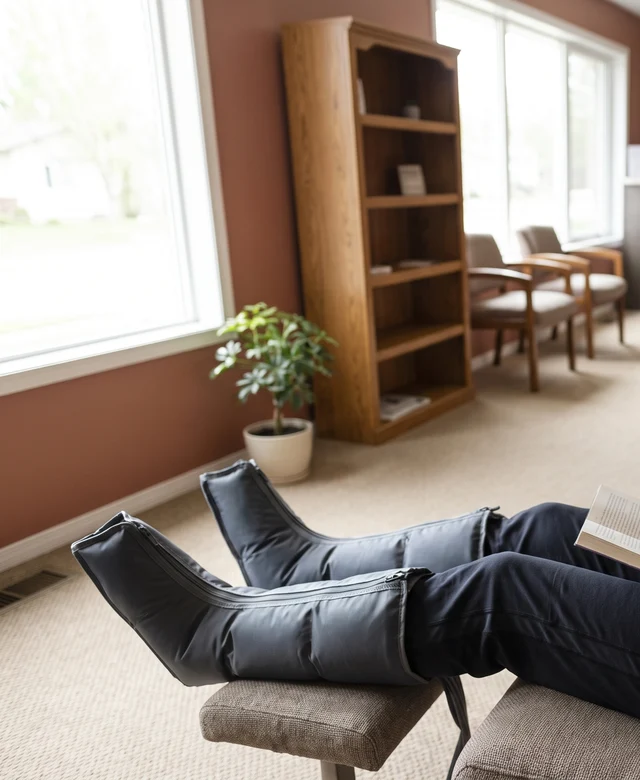
Compression boots are added onto the end of a regular visit, not booked on their own. You sit or recline while the boots inflate and release in a wave pattern up the limb, at a pressure your Doctor of Physical Therapy sets and adjusts based on how the area’s responding.
Most sessions run 15 to 20 minutes, often while you ice, stretch, or simply rest after the harder work of the visit is done. You leave with less heaviness in the limb than you walked in with, which is the point: recovery, not a stand-alone fix.
Who this is for, and who it isn’t.
Compression boots tend to fit people training or recovering hard enough that soreness and swelling are slowing down the next visit: the athlete stacking sessions through a heavy block, or the patient a few weeks post-surgery whose limb still feels heavy by evening. It’s most useful as an add-on once your evaluation has already identified the actual plan it’s supporting.
The people who ask for it are usually already doing the harder work elsewhere in the plan and want to recover fast enough to keep doing it.
It’s not appropriate for an active blood clot or clotting disorder, an open wound or active infection in the area, or uncontrolled heart failure; your evaluation screens for these before it’s ever added to a visit.
Good fit
- Training or recovering hard enough that swelling is slowing the next visit
- Already inside an evaluated plan, using it as a recovery add-on
- Post-surgical swelling that’s lingering past the incision healing
- Comfortable with sustained pressure around the limb
Not the right fit
- An active blood clot or clotting disorder
- An open wound or active infection in the area
- Uncontrolled heart failure or circulatory conditions (screened at evaluation)
It’s a recovery tool inside the plan, never a stand-alone treatment.
“I have had only 2 sessions so far. I have had a positive experience working with Bryan. He has been attentive and easy to work with.”Sandy N. · Google review
Questions, answered plainly.
No. The pressure is firm and rhythmic, not painful, and your Doctor of Physical Therapy sets the intensity based on how the area is responding. Most people find it relaxing, and many use the time to ice or stretch at the same time.
No. They’re a recovery tool, not a treatment. Compression boots move fluid and ease heaviness after exertion or injury, but they don’t find the cause of pain or fix a joint that isn’t moving correctly. Here, they’re always added inside a plan a Doctor of Physical Therapy has already built around you.
Here, no. Compression boots are scheduled as an add-on inside an existing physical therapy plan, following a cause-first evaluation that confirms it’s a good fit for you. That evaluation also screens for the few conditions, like clotting disorders, where compression isn’t appropriate.
It depends on your training load and where you are in your plan. Some patients use it after every visit during a heavy block in Perform; others use it occasionally, when swelling or heaviness is slowing recovery. Your Doctor of Physical Therapy will tell you at your evaluation whether it fits your plan at all.
Start with the evaluation that builds your recovery plan.
Put it in writing.
Five short questions. A real person calls you back, usually within two business hours, with times that fit your week.
The people who end up filling this out are rarely in the worst pain of their life. They’re just done working around it, done picking the errand that doesn’t require the stairs. If that’s the stage you’re at, this is the part where you stop researching and start.
Consider it filed.
A real person will call you back, usually within two business hours, with appointment times that fit your week. Keep your phone nearby.
Can’t wait? Call (515) 207-2450 ⟶Easy to find. Easy to park.
In the neighborhood, with parking by the door. Come see the place before you commit, if you like.
The clinic · Kaizen Health and Wellness
Get Directions ⟶Opens in Google Maps